

Wrinkles should merely indicate where smiles have been.
Every person on earth will undergo the aging process known as Senescence or “biological aging.” Mother Nature cannot be avoided, but when the physical signs of aging occur (usually through many factors, including the depletion of stem cells) and start to take hold, there are ways to manage the process through science. Our functional medicine doctors can help you support healthy aging through proper diet and healthy habits, and stem cell therapy for Anti-aging and wellness is being studied as an investigational option. Check out our FAQ section for more information.
Around 170,000 people across the world die every day, and most of those deaths are due to age-related diseases. There are several scientific hypotheses about why the aging process or “senescence” occurs. Some believe that aging symptoms, such as zombie cells, are pre-programmed gene expressions, while others believe that the cumulative damage of the biological processes causes it.
Research on cellular aging covers many separate questions. A change in a cell marker, skin appearance or a specific disease outcome cannot establish that a treatment slows aging across the body.
Does stem cell therapy work for anti-aging?
Stem cells are found in all humans and help the body maintain and repair some tissues. However, their natural repair capacity is limited, and they do not allow quick recovery from spinal cord injuries, sports injuries, or degenerative conditions such as diabetes, kidney disease, and heart and liver disease. Stem cell rejuvenation provides the nutrients and instructions for a stronger and healthier body. Robust immune systems are not easily prone to certain illnesses and diseases. When functioning normally, your body can easily defend itself against harmful bacteria and viruses.
Exosomes for General Wellness
Exosomes are tiny vesicles that cells release as messengers to other cells, and researchers are studying whether they could support tissue repair. Complementary practices such as cold water immersion work in a different way and are not a form of exosome therapy. Because they naturally carry proteins, genetic materials, and signaling molecules, exosomes can be harnessed to deliver therapeutic cargo to specific cells without the need for transplanting entire cell populations.
Laboratory findings about tissue repair do not establish improvements in appearance, joint health or physical function after a wellness treatment.
The body’s own repair processes and the effects of a marketed cell product are different questions.

Evidence for wellness claims
Evaluate the specific product, population and outcome behind each claim. Examples of questions to ask include:
- Was the outcome measured in people or in a laboratory?
- Did the study compare the treatment with standard care or a control group?
- How long did the study track outcomes and adverse events?
- Medication use: claims about a wellness cell program do not justify reducing or stopping prescribed medicines. Any medication change requires individual clinical assessment.
Age Management with Stem Cell Therapies
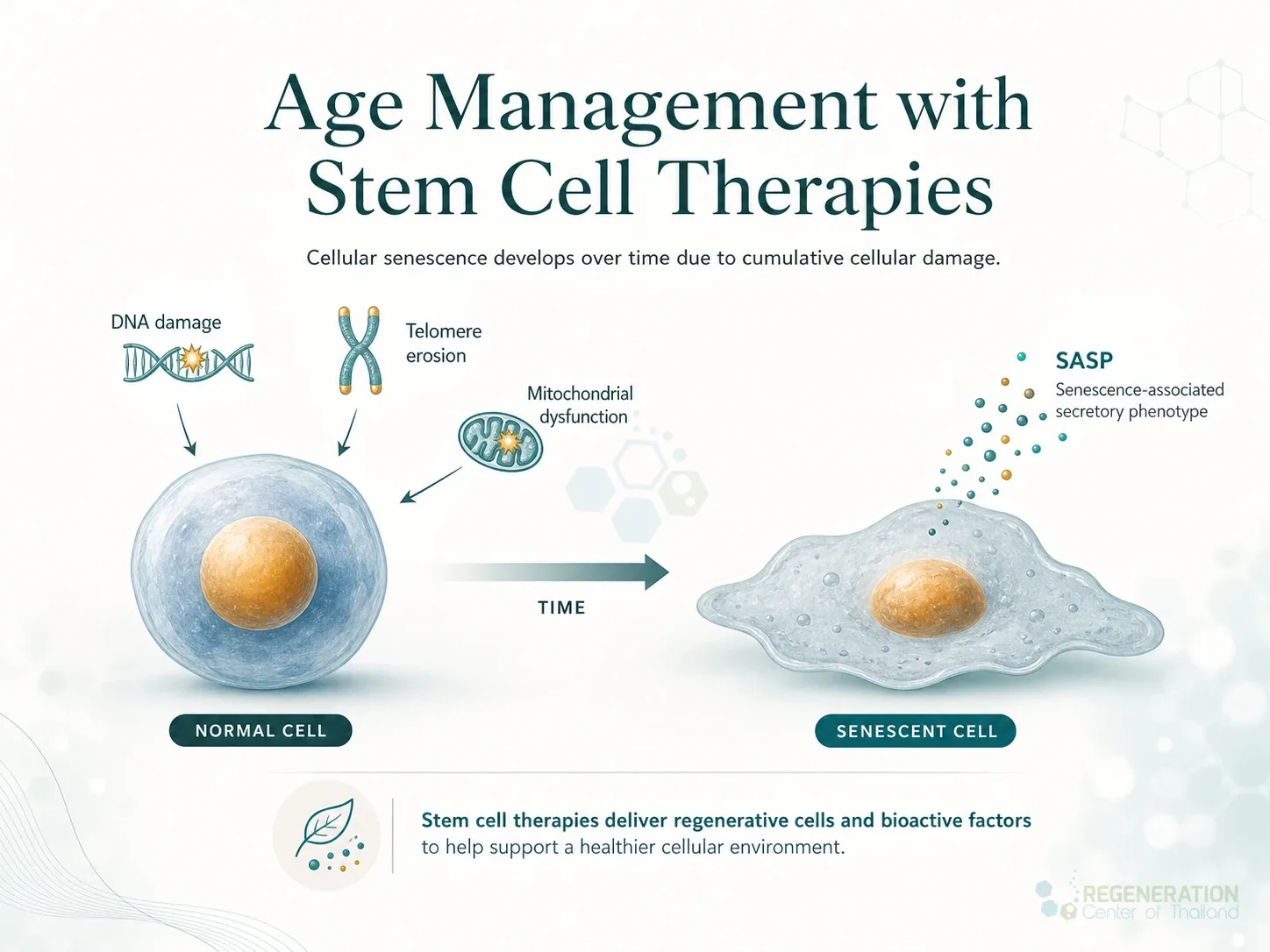
The term UC-MSC refers to mesenchymal stromal cells sourced from umbilical cord tissue. Autologous means the cells come from the person receiving them. Ask for the exact source and product description before drawing conclusions about any branded program.
For a proposed wellness intervention, ask whether the provider can show human evidence for that exact product, its intended result and its risks. The US FDA consumer guidance on regenerative medicine products describes why product-specific verification matters.
What a patient story can tell you
Benefits of Anti-Aging Cellular Therapies
A patient’s experience cannot establish how likely someone else is to benefit or have a side effect.
Mood, energy, sexual health, cardiovascular function, neurological symptoms and skin appearance are different outcomes. Findings in one disease or laboratory setting do not establish broad anti-aging or wellness benefits from a particular cell program. The cited material should be assessed for the actual intervention and outcome; it does not justify guarantees of pain elimination, rejuvenation, instant cosmetic changes or superior results. [2][3]
Questions before making a wellness plan
Ask a qualified clinician which established options fit your goals and whether any proposed intervention has evidence for the outcome you want.
Define what you want a wellness evaluation to address
People seeking age-management care often use the same word for very different goals. Some want to maintain strength and mobility. Others want help understanding fatigue, changes in sleep or a decline in exercise tolerance. Someone may also want to review a claim they read about stem cells or exosomes. Start by naming the change you want to discuss, how long it has been present and how it affects daily life. That gives the clinician a basis for deciding what to assess and how to tell whether a proposed change is meaningful.
Bring a medication and supplement list, a short medical history and recent results that relate to your goal. Include any ongoing care and changes that occurred before the concern began. A wellness assessment can lead to questions about existing conditions, preventive care or whether another clinician should investigate a particular symptom. Asking about a specific intervention can be part of the discussion, but the clinician needs enough context to assess what addresses the concern.
Separate healthy aging from a claim to reverse aging
Healthy aging usually has concrete goals such as continuing to walk independently, staying engaged in activities or managing a condition that affects daily life. Start by discussing established options with a clinician who understands your health. The National Institute on Aging guide explains the evidence behind physical activity, sleep, nutrition and preventive care. Which steps fit depends on current health, abilities and preferences.
Claims to reverse aging are broader. A study might report a change in a biomarker, appearance or a short-term test. Ask what was actually measured and whether the study showed a change in function or health that people could notice and that lasted. For example, a result about a skin measurement cannot show that an intervention preserves muscle strength. A generalized claim about wellness should make clear which specific result the evidence supports.
What cell source and preparation tell you
Autologous means a product comes from the person receiving it. Donor-derived products come from another person. Umbilical cord blood and umbilical cord tissue are different sources. The source name alone leaves important questions open, including what the preparation contains, what it is intended to accomplish and whether the same product was evaluated in people. If a provider uses a brand name, ask for the full description used in its evidence or trial documents. Names that sound alike may refer to different preparations.
Exosomes are a type of small particle that cells release. Studies of how cells communicate in a laboratory are different from studies of administering a particular product to people. When you read a claim about an exosome product, identify the product and check whether there are studies of that exact preparation for the reason it is being discussed. The US FDA consumer alert about regenerative medicine products outlines questions people can ask about such claims. For an assessment in another country, ask the clinician about the requirements that apply where care would take place.
Read a wellness study in five steps
- Identify the participants. A study enrolling people with a diagnosed disease may answer a question about that condition. Check whether the people studied had goals and health characteristics comparable to yours.
- Identify the intervention. Write down the exact product and how the study describes it. If an evaluation mentions a different preparation, ask what research applies specifically to it.
- Find the main outcome. Determine whether the researchers measured daily function, symptoms, appearance or a marker. Decide how relevant that outcome is to the reason you are seeking care.
- Look for a comparison. See what the comparison group received and whether follow-up was similar. A change over time can reflect other care, measurement variation or changes in routine.
- Check safety and duration. Look for who completed the study, what adverse events were recorded and how long participants were followed. A study that ends shortly after an intervention tells you little about longer-term results.
If a paper is behind a paywall or difficult to interpret, ask the evaluating clinician to explain the main findings and show how they relate to your goal. Bring the title or public trial identifier. Phrases such as clinically tested need a specific study and result to be meaningful. Keep the author’s stated limitations with any positive result when comparing claims.
Interpret testimonials in the context of your goals
A personal story can illustrate the questions someone asked or how they organized their care. It describes that person’s experience. It usually cannot show how often other people improve, how often problems occur or what caused a change when several things happened around the same time. Use a story to identify questions for an appointment, then ask for study results if it makes a claim about effectiveness or safety.
Compare how the outcome is described before and after. A person might talk about energy, while a clinician measures walking ability, sleep or another outcome. Ask whether the reported change was measured consistently and what else was happening at the same time. For your own evaluation, name the activity or symptom that matters and describe how it is now. This helps the clinician explain which options address it and what follow-up could show.
Prepare for a decision about care and follow-up
Ask what the evaluating team can determine from the records and what would need an in-person assessment. If the team proposes any service, ask who would provide it, which goals it addresses, what other options are available and what care would continue with your usual clinician. Discuss the expected follow-up, who to contact if a symptom changes and what documentation you would receive. If travel is involved, ask whether the evaluation can clarify options before you commit to a visit.
A useful comparison includes the total planned services, the evidence for the proposed result and the practical obligations after the appointment. If the plan includes follow-up, clarify whether visits can take place locally and how information will be shared. Discuss medication changes with the clinician who prescribes the medicines. Write down what is understood and which questions still need answers before you make a decision.
Questions for an individualized wellness review
- Which current health conditions, symptoms or medicines should be considered first?
- What goal can the evaluation help define and how would we measure a meaningful change?
- Which options have evidence for that goal and are relevant to my current health?
- If a cell or exosome product is discussed, what exact product was studied and what did the study show?
- Who would provide the service, what would follow-up include, and who would coordinate with my usual clinicians?
Bring these questions together with a short summary of your goals, previous assessments and ongoing care. The discussion can then focus on choices that relate to your circumstances and the information you would need to weigh them.
Questions about biological age tests
If a wellness service offers a biological age result, ask how the estimate was made, what factors can change the measurement and how reproducible it is. Find out whether the test was studied in people comparable to you and whether a change in the score has been linked to an outcome you value. Ask whether the number would change a decision about your care. If it would, the evaluator should be able to explain how the proposed decision follows from the finding.
Distinguish a test result from an assessment of how you feel or function. If a practical goal is to maintain mobility, describe the activity you want to keep doing and the challenges you currently have. Look for evidence about that activity, including how long any improvement lasted. A single result after a program provides limited information about why it changed. When you discuss the result with your clinician, ask which other factors should be considered before drawing a conclusion about an intervention.
Discuss your wellness goals
The Regeneration Center offers individualized wellness and age-management care after a full medical evaluation. The team considers your health history, current care and goals before discussing whether any service is appropriate for you.
Published Clinical Citations
[1] Jin, Hye Jin, Yun Kyung Bae, Miyeon Kim, Soon-Jae Kwon, Hong Bae Jeon, Soo Jin Choi, Seong Who Kim, Yoon Sun Yang, Wonil Oh, and Jong Wook Chang. 2013. Comparative analysis of human mesenchymal stem cells from bone marrow, adipose tissue, and umbilical cord blood as sources of cell therapy. International journal of molecular sciences, no. 9 (September 3). doi:10.3390/ijms140917986. https://www.ncbi.nlm.nih.gov/pubmed/24005862
[2] ^ Manosroi, Aranya, Pensak Jantrawut, Toshihiro Akihisa, Worapaka Manosroi, and Jiradej Manosroi. 2011. In vitro and in vivo skin anti-aging evaluation of gel containing niosomes loaded with a semi-purified fraction containing gallic acid from Terminalia chebula galls. Pharmaceutical biology, no. 11. doi:10.3109/13880209.2011.576347. https://www.ncbi.nlm.nih.gov/pubmed/22014267
[3] ^ Rinaldi, S, M Maioli, G Pigliaru, A Castagna, S Santaniello, V Basoli, V Fontani, and C Ventura. 2014. Stem cell senescence. Effects of REAC technology on telomerase-independent and telomerase-dependent pathways. Scientific reports (September 16). doi:10.1038/srep06373. https://www.ncbi.nlm.nih.gov/pubmed/25224681