

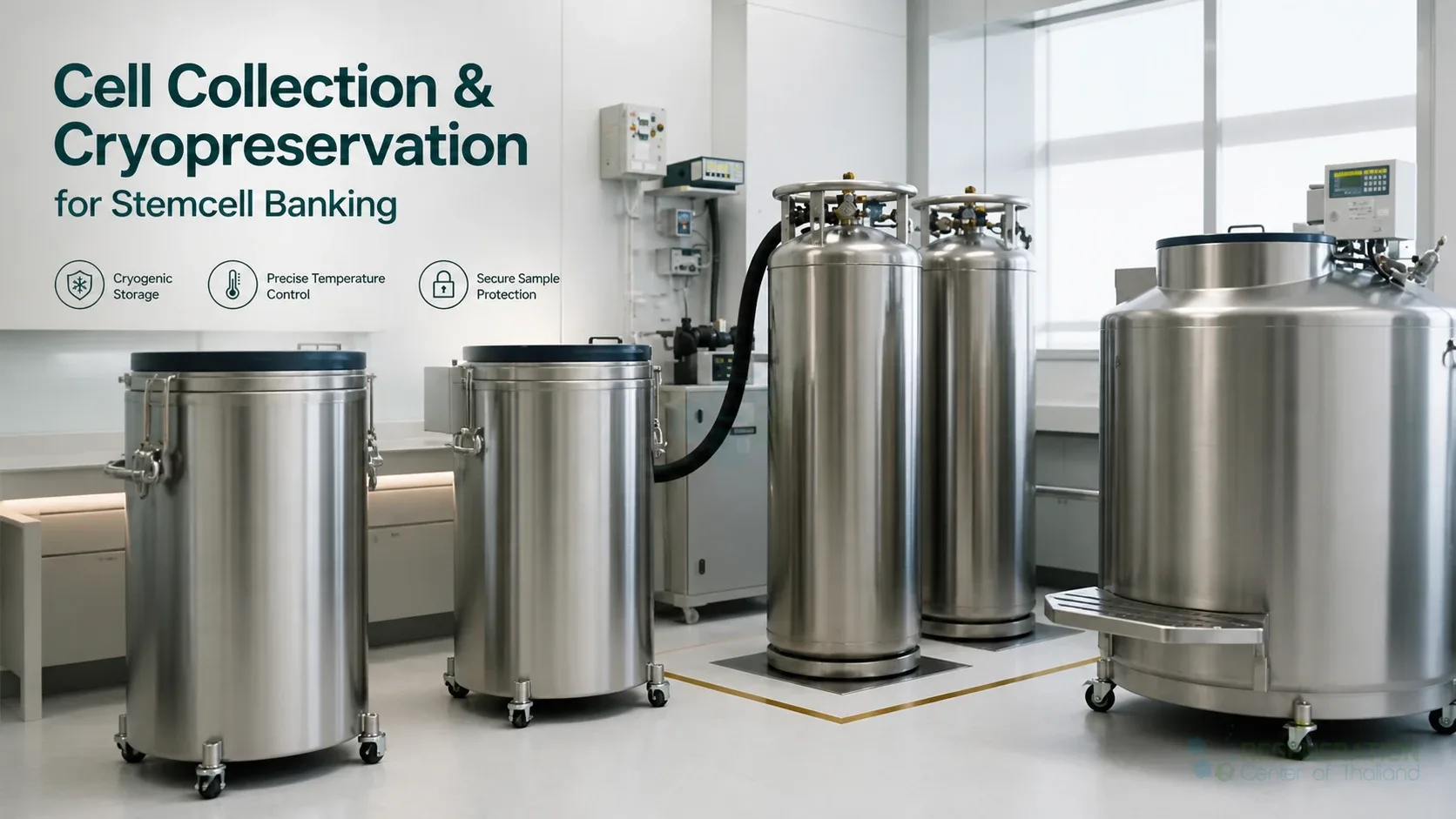
Stem cell banking means collecting cells, freezing them and storing them for possible later use, either by the person they came from or by a relative or, in a public bank, by an unrelated patient. Stem cell banking is sometimes compared to insurance. Banked cells do not guarantee a future treatment, because most conditions have no proven stem cell therapy, and whether stored cells can be used depends on the condition and on medical advice at the time.[1][2] This page explains how cells are collected and frozen, which cells can be stored, what professional bodies say about private banking, and what to ask a bank.
Stem Cell Preservation
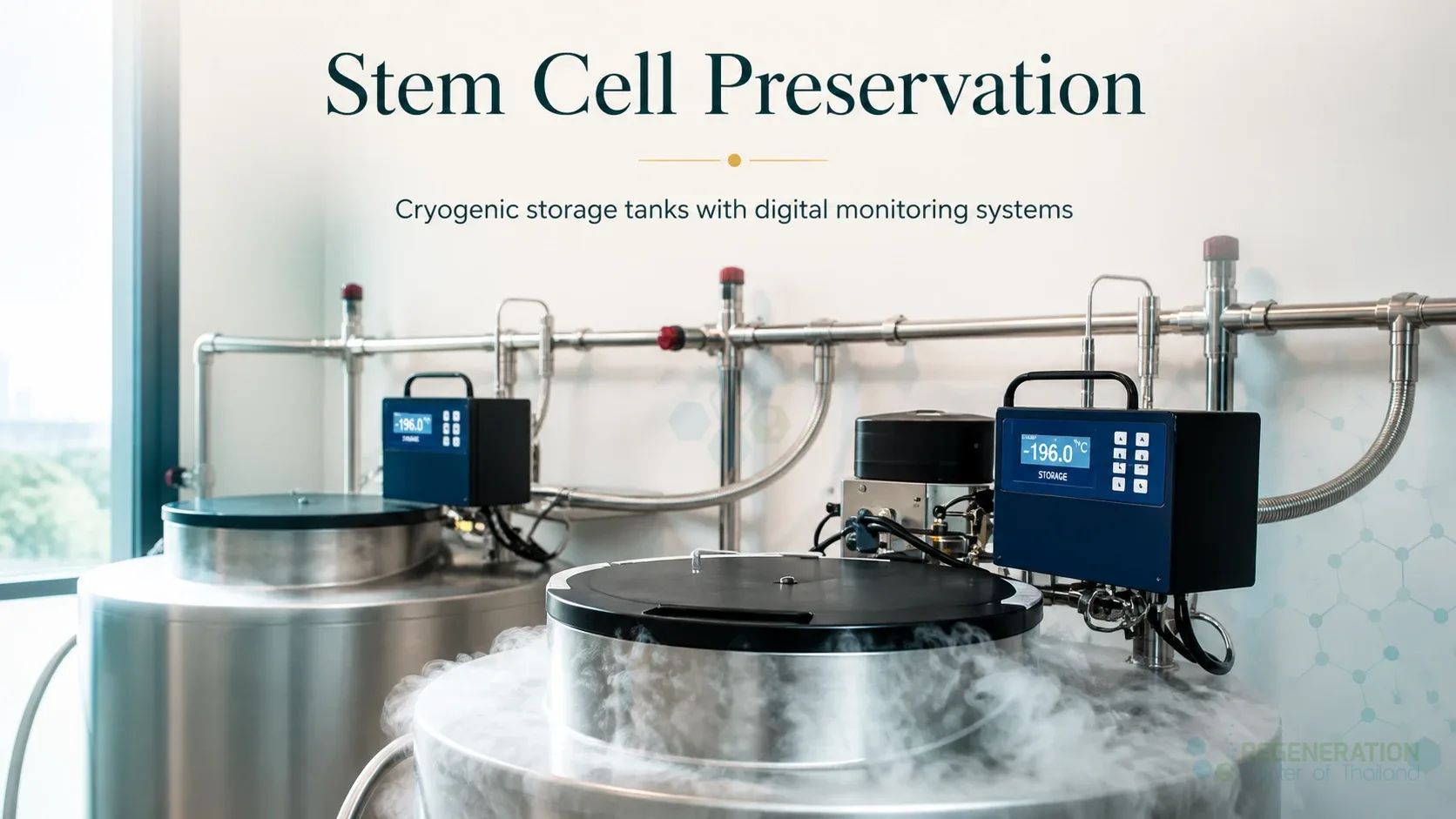
Cryopreservation is the preservation of cells or tissues by freezing.[3] Osmotic stress during freezing is a main cause of cell death, so a cryoprotective agent is added first; the usual method uses 10% dimethyl sulfoxide (DMSO), cooling at about 1 °C per minute, and storage in liquid nitrogen or in the cold vapour above it.[4] For blood-forming stem cells, freezing allows cells to be transported from the processing laboratory to the place of treatment and leaves time for quality control and regulatory testing; DMSO given with the thawed cells can cause side effects in patients, which is why methods that use less of it are being developed.[5] In one laboratory study of mesenchymal stromal cells from umbilical cord tissue, slow freezing at 1 °C per minute with 10% DMSO, with or without sucrose, kept 85% to 87% of cells alive, while rapid freezing by vitrification kept 18%.[6]
Frozen cells can remain usable for many years. Cord blood units frozen for up to 23.5 years recovered 80% to 100% of their blood progenitor cells compared with the same units before freezing, although some collections had low recovery, and cells from units frozen for up to 21 years repopulated the blood system of immunodeficient mice for at least six months.[7] How long stored cells remain suitable for treatment in people is still being studied.
Currently, we offer liquid nitrogen storage for:
- Peripheral Blood Stemcells
- Exosomes (cell-derived vesicles, not cells)
- Cord Tissue-Derived Mesenchymal Cells
- Cord Blood Stem Cells
- Amniotic Fluid and Amniotic Membrane Derived Stem Cells
- Wharton Jelly Preservation
- Placenta Derived
- Dental Pulp Mesenchymal Cells
Wharton’s jelly is the jelly-like connective tissue of the umbilical cord, and it contains mesenchymal stromal cells;[8] amniotic fluid and the amniotic membrane are different tissues. Our cryogenic laboratories can collect and store umbilical cord blood cells long term in liquid nitrogen.
How Cells Are Collected
Collection of cord blood, amniotic, Wharton’s jelly or placenta cells usually happens the day you give birth. Parents who want cord blood collected must arrange it with a cord blood bank before the baby is born.[9] Collection takes place after the baby is born and the cord is clamped and cut; donating cord blood involves no risks to the mother or the baby.[9] Collection should not compromise the care of mother or newborn or change the routine practice of delayed cord clamping, and the condition of mother or baby may prevent an adequate collection, so parents should discuss timing with their obstetrician.[10] Typically, the standard procedure requires the doctors to clamp and save the baby’s umbilical cord.
The Regeneration Center offers several methods of collecting stem cells, and our team will explain what each method involves, including any discomfort or risks. Other sources are collected at other times. Bone marrow is drawn with a needle from the hip bone under anesthesia; peripheral blood stem cells are collected by apheresis after four to five days of a medicine that moves stem cells into the bloodstream; and bone marrow stem cells can be frozen and kept for many years.[9] Bone marrow, mobilized peripheral blood and cord blood can all supply the cells for a blood-forming stem cell transplant.[11] Similar stem cells are found in the pulp of adult and baby teeth and in the developing root tip (apical papilla).[12] More is on our pages on bone marrow stem cells and on fat-derived cells, the stromal vascular fraction.
Cord blood, cord tissue and dental pulp are different starting materials. Families should ask which material is collected, what testing and storage standards apply, and which uses have clinical evidence. The collection and storage agreement should describe the actual service. The American College of Obstetricians and Gynecologists advises that families be told which quality control and regulatory organizations oversee the collection and storage.[10]
What Banked Cells Are Used For
Cord blood contains blood-forming stem cells, which are routinely used to treat cancers such as leukemia and lymphoma and other disorders of the blood and immune systems.[2] Since the first successful cord blood transplant in 1988, the American College of Obstetricians and Gynecologists estimated in 2019 that more than 35,000 cord blood transplants had been performed in children and adults for inborn errors of metabolism, blood cancers and genetic disorders of the blood and immune system.[10] Blood-forming stem cells make blood and immune cells; without careful laboratory manipulation, tissue-specific stem cells do not make the cells of other organs.[13] Uses of stem cells for other conditions are still being studied, as explained on our page about stem cell therapy; gene therapy is covered on our page on gene therapies.
A child’s own cord blood has important limits. It cannot be used to treat a genetic disease or a cancer in that same child, because it carries the same genetic variant or premalignant cells, and there is no current evidence to support using a child’s own cord blood in regenerative medicine.[10] For some inherited diseases, stored cord blood may not be recommended for the child’s treatment.[2] For banked dental pulp, the American Academy of Pediatric Dentistry states that no treatment using harvested dental stem cells is currently available in humans.[14]
Hematopoietic Cell Banking
Hematopoietic (blood-forming) stem cells are used mainly to rebuild the blood and immune system, for example in transplants for leukemia, lymphoma, and some inherited blood disorders.[2][15] Stem cell transplants are also used for some autoimmune disorders.[15] Cord blood transplants may not need as exact a tissue match as transplants of bone marrow or blood stem cells.[2] After a transplant, blood-forming stem cells travel through the bloodstream to the bone marrow, where they take the place of the cells destroyed by treatment, a process called homing;[15] claims that injected cells will find and repair damaged tissue elsewhere are a warning sign rather than an established effect.[13] How cells signal to one another is described on our page on paracrine signaling.
Public and private banks serve different purposes. A public bank stores donated units for any matching patient; in the United States such units must be licensed by the Food and Drug Administration (FDA) or used under an investigational application. A private bank stores a unit for the child or a first- or second-degree relative; it must register with the FDA and follow its rules on donor screening, infectious disease testing and tissue handling, and registration does not mean the FDA endorses the bank.[2] Professional bodies advise against routine private banking:
- The American College of Obstetricians and Gynecologists (2019) states that routine private cord blood banking is not supported by the available evidence and that public banking is the recommended way to obtain cord blood.[10]
- The American Academy of Pediatrics (2017) notes that public banking is free for families, while private banking is costly, not covered by insurance and the unit may never be used, and that quality reviews by accrediting bodies show private banks to be underused for treatment, less regulated for quality control and more expensive than public banks.[1]
Stem Cell Storage Guidelines & Costs
Prices for preserving stem cells or cord cell banking depend on the quantity and length of storage needs (up to 20 years). Public banking of donated cord blood is free for families, while commercial banks charge to store cord blood for a family’s private use.[9] Before signing a storage agreement, families can ask the bank which quality control and regulatory organizations oversee it[10] and what the full cost will be, because private storage is costly and not covered by insurance.[1]
Published Clinical Citations
[1] ^ Shearer WT, Lubin BH, Cairo MS, Notarangelo LD; Section on Hematology/Oncology; Section on Allergy and Immunology. Cord blood banking for potential future transplantation. Pediatrics. 2017;140(5):e20172695. https://doi.org/10.1542/peds.2017-2695
[2] ^ US Food and Drug Administration. Cord Blood Banking: Information for Consumers. Content current as of 23 March 2018. https://www.fda.gov/vaccines-blood-biologics/consumers-biologics/cord-blood-banking-information-consumers
[3] ^ National Library of Medicine. Cryopreservation (MeSH descriptor D015925). Medical Subject Headings. https://meshb.nlm.nih.gov/record/ui?ui=D015925
[4] ^ Whaley D, Damyar K, Witek RP, Mendoza A, Alexander M, Lakey JR. Cryopreservation: an overview of principles and cell-specific considerations. Cell Transplantation. 2021;30:963689721999617. https://doi.org/10.1177/0963689721999617
[5] ^ Hornberger K, Yu G, McKenna D, Hubel A. Cryopreservation of hematopoietic stem cells: emerging assays, cryoprotectant agents, and technology to improve outcomes. Transfusion Medicine and Hemotherapy. 2019;46(3):188-196. https://doi.org/10.1159/000496068
[6] ^ Balci D, Can A. The assessment of cryopreservation conditions for human umbilical cord stroma-derived mesenchymal stem cells towards a potential use for stem cell banking. Current Stem Cell Research & Therapy. 2013;8(1):60-72. https://doi.org/10.2174/1574888×11308010008
[7] ^ Broxmeyer HE, Lee MR, Hangoc G, et al. Hematopoietic stem/progenitor cells, generation of induced pluripotent stem cells, and isolation of endothelial progenitors from 21- to 23.5-year cryopreserved cord blood. Blood. 2011;117(18):4773-4777. https://doi.org/10.1182/blood-2011-01-330514
[8] ^ National Library of Medicine. Wharton Jelly (MeSH descriptor D059631). Medical Subject Headings. https://meshb.nlm.nih.gov/record/ui?ui=D059631
[9] ^ National Cancer Institute. Donating Blood Stem Cells for Stem Cell Transplants. https://www.cancer.gov/about-cancer/treatment/types/stem-cell-transplant/donating-blood-stem-cells
[10] ^ American College of Obstetricians and Gynecologists. ACOG Committee Opinion No. 771: Umbilical cord blood banking. Obstetrics & Gynecology. 2019;133(3):e249-e253. https://doi.org/10.1097/AOG.0000000000003128
[11] ^ Rao M, Ahrlund-Richter L, Kaufman DS. Concise review: cord blood banking, transplantation and induced pluripotent stem cell: success and opportunities. Stem Cells. 2012;30(1):55-60. https://doi.org/10.1002/stem.770
[12] ^ Kawashima N. Characterisation of dental pulp stem cells: a new horizon for tissue regeneration? Archives of Oral Biology. 2012;57(11):1439-1458. https://doi.org/10.1016/j.archoralbio.2012.08.010
[13] ^ International Society for Stem Cell Research. Nine Things to Know About Stem Cell Treatments. About Stem Cells. https://www.aboutstemcells.org/stem-cells-medicine/nine-things-to-know-about-stem-cell-treatments/
[14] ^ American Academy of Pediatric Dentistry. Policy on using harvested dental stem cells. The Reference Manual of Pediatric Dentistry. American Academy of Pediatric Dentistry; 2026:222-223. https://www.aapd.org/globalassets/media/policies_guidelines/p_stemscells26.pdf
[15] ^ National Cancer Institute. Stem Cell Transplants in Cancer Treatment. https://www.cancer.gov/about-cancer/treatment/types/stem-cell-transplant
