

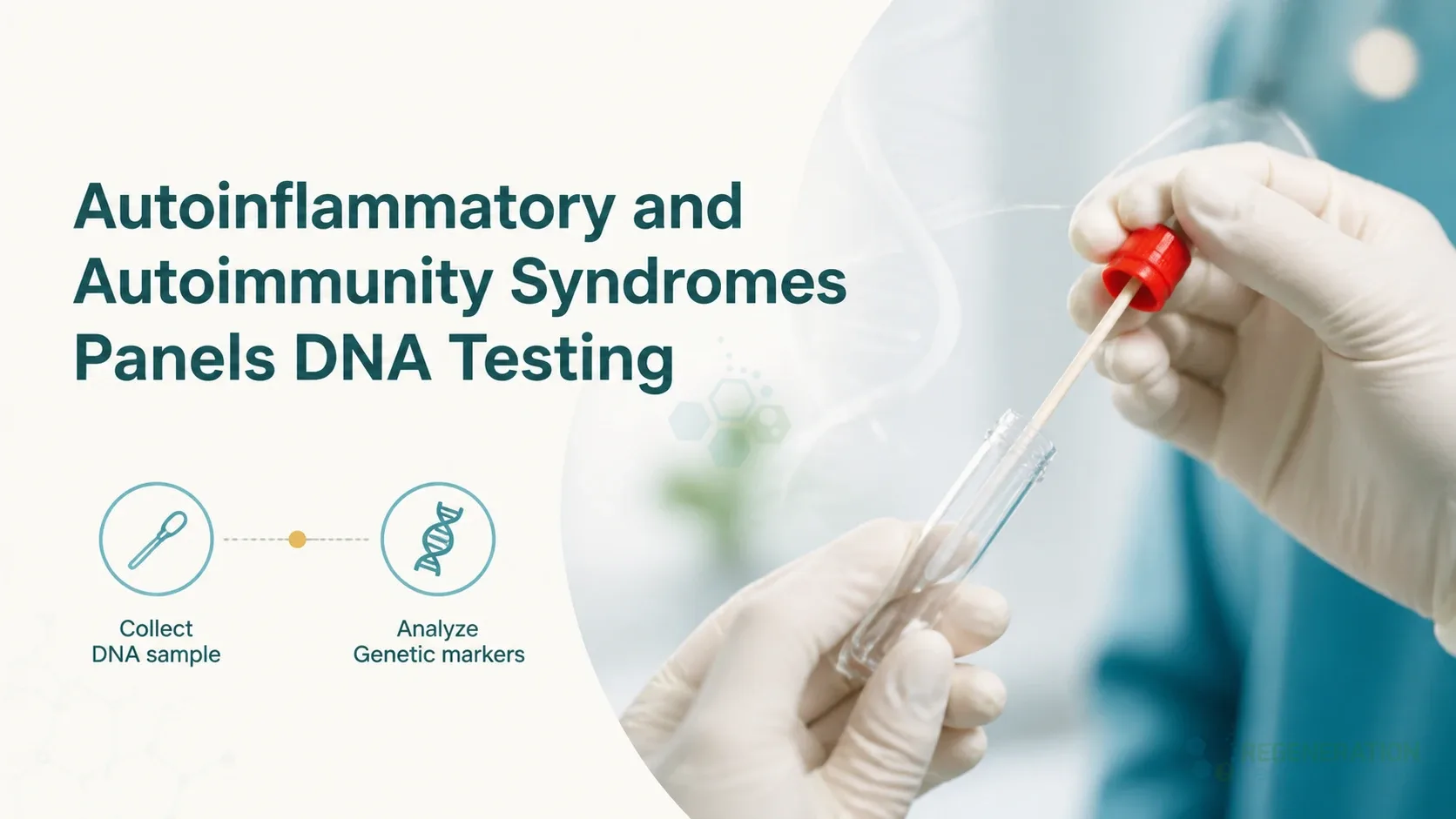
The Regen Center offers Autoinflammatory and Autoimmunity Syndromes DNA test to analyze genes that are associated with autoinflammatory and autoimmune diseases. Autoinflammatory disorders are mainly characterized by episodes of systemic inflammation caused by inappropriate activation of the innate immune system. Alternatively, autoimmune diseases are usually caused by some defects in adaptive immunity that over time leads to a loss of self-tolerance. Autoinflammatory & Autoimmune diseases both share similar symptom manifestations including self-directed inflammation in the absence of a known cause. Genetic testing is usually considered for people with features that suggest an inherited condition, such as recurrent unexplained fevers, early-onset or unusual autoimmunity, or an affected family member, and it should be ordered and interpreted with the treating doctor. A negative result does not rule out disease, some results are variants of uncertain significance, and genetic counselling is recommended before and after testing.
Primary DNA Test Panels for Autoinflammatory and Autoimmunity Syndromes include the genes below. Many of them are also linked to primary immunodeficiencies (inborn errors of immunity), which can cause autoimmunity or inflammation:
- ACP5
- ADA
- ADA2
- ADAM17
- ADAR
- AICDA
- AIRE
- ANKZF1
- AP3B1
- ARPC1B
- ASAH1
- BACH2
- BLOC1S6
- BTK
- CYBC1 (formerly C17orf62)
- CARD14
- CARD8
- CASP10
- CASP8
- CCBE1
- CD27
- CD3G
- CD40
- CD40LG
- COPA
- CR2
- CTLA4
- CYBA
- CYBB
- DCLRE1C
- RIGI (formerly DDX58)
- DEF6
- DKC1
- DNASE1L3
- DNASE2
- DOCK8
- DSG1
- DUOX2
- ELANE
- FADD
- FAS
- FASLG
- FCHO1
- FOXP3
- G6PC3
- ICOS
- IFIH1
- IL10
- IL10RA
- IL10RB
- IL1RN
- IL21
- IL21R
- IL2RA
- IL2RB
- IL2RG
- IL36RN
- IRF2BP2
- ITCH
- ITGAM
- ITGB2
- ITK
- JAK1
- LIG4
- LPIN2
- LRBA
- LYN
- LYST
- MAGT1
- MEFV
- MVK
- NCF2
- NCF4
- NFAT5
- NFKB1
- NFKB2
- NFKBIA
- NLRC4
- NLRP1
- NLRP12
- NLRP3
- NOD2
- OAS1
- ORAI1
- OTULIN
- PEPD
- PIK3CD
- PIK3R1
- PLCG2
- PNP
- POLA1
- POMP
- PRF1
- PRKCD
- PSMA3
- PSMB4
- PSMB8
- PSMG2
- PSTPIP1
- RAB27A
- RAC2
- RAG1
- RAG2
- RASGRP1
- RBCK1
- RFX5
- RFXANK
- RFXAP
- RIPK1
- RMRP
- RNASEH2A
- RNASEH2B
- RNASEH2C
- RNF31
- RTEL1
- SAMHD1
- SCO2
- SH2D1A
- SH3BP2
- SI
- SIAE
- SKIC2 (formerly SKIV2L)
- SLC29A3
- SLC37A4
- SLC7A7
- STAT1
- STAT3
- STAT4
- STAT5B
- STIM1
- STX11
- STXBP2
- TBX1
- TGFB1
- TGFBR1
- TGFBR2
- STING1 (formerly TMEM173)
- TNFAIP3
- TNFRSF11A
- TNFRSF13B
- TNFRSF13C
- TNFRSF1A
- TNFRSF6B
- TNFSF12
- TOP2B
- TPP2
- TREX1
- TRNT1
- TTC7A
- UNC13D
- UNG
- WAS
- XIAP
- ZAP70
- ZNF341
Optional
Additional panels for autoimmune and immune dysregulation disorders caused by defects in adaptive immunity leading to loss of self-tolerance.
Autoimmune and autoinflammatory diseases often share clinical manifestations, and overlap between these disease groups has been recognized. Both types of conditions result in self-directed inflammation and recent research suggests considerable overlapping of molecular pathways that are involved in both.
- AIRE
- AP3B1
- BLOC1S6
- CASP10
- CASP8
- CD27
- CR2
- FADD
- FAS
- FASLG
- IL21R
- ITCH
- ITK
- LYST
- MAGT1
- NFKB2
- NFKBIA
- ORAI1
- PNP
- PRF1
- PRKCD
- RAB27A
- RAC2
- RFX5
- RFXANK
- RFXAP
- RMRP
- SLC7A7
- STAT5B
- STX11
- TBX1
- TNFRSF13B
- TNFRSF13C
- TNFSF12
- TPP2
- UNC13D
- UNG
Published Clinical Citations
[1] ^ Ciccarelli, F., De Martinis, M., & Ginaldi, L. (2014). An update on autoinflammatory diseases. Current medicinal chemistry, 21(3), 261–269.https://doi.org/10.2174/09298673113206660303
[2] ^ Arakelyan A, Nersisyan L, Poghosyan D, Khondkaryan L, Hakobyan A, Löffler-Wirth H, Melanitou E, Binder H. Autoimmunity and autoinflammation: A systems view on signaling pathway dysregulation profiles. PLoS One. 2017 Nov 3;12(11):e0187572. doi: 10.1371/journal.pone.0187572. PMID: 29099860; PMCID: PMC5669448https://pubmed.ncbi.nlm.nih.gov/29099860/
