
Early-stage liver disease usually causes no symptoms. Most people with fatty liver disease have no symptoms or only vague ones, and many people with cirrhosis, the stage of heavy scarring, have none early on.[1][2] When researchers tested adults in the general population with blood tests and scans that measure liver scarring, about 1 to 2 in every 100 had advanced scarring that had not been diagnosed, and the share was higher in people with fatty liver, type 2 diabetes, or hazardous drinking.[3] Worldwide, the most common causes of cirrhosis are viral hepatitis, alcohol-related liver disease and fatty liver disease (MASLD).[4]
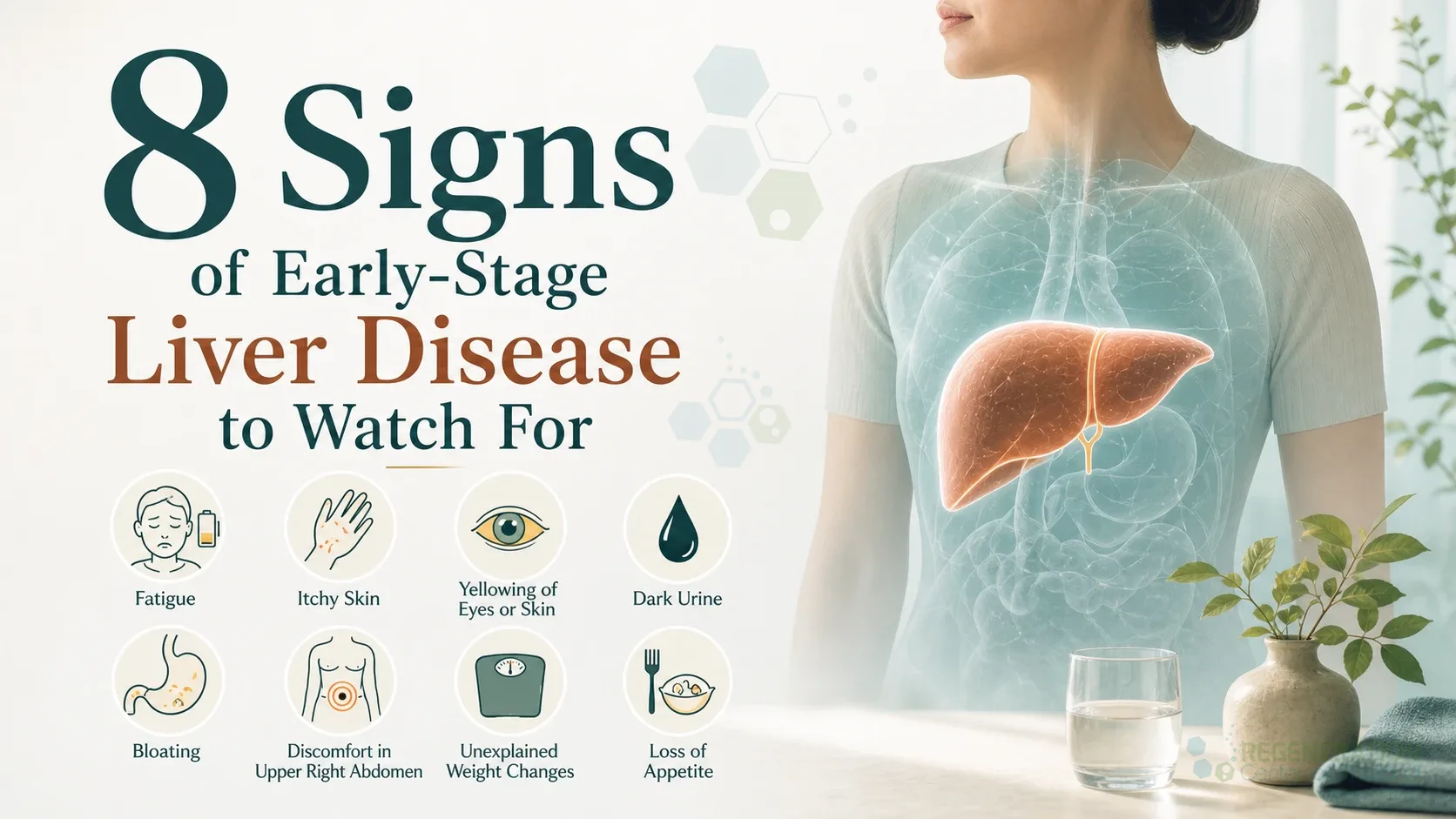
This matters for anyone reading a list of warning signs. The eight signs below are the ones people most often notice and ask about. A few, such as tiredness or loss of appetite, can appear while liver disease is at an early stage, but they are common and have many other causes. Most of the others, including easy bruising, yellow skin or eyes, dark urine with pale stools, and fluid swelling, usually appear when liver disease is already advanced or when bile cannot drain properly. Waiting for symptoms is therefore not a safe way to find liver disease early. Testing based on your risk factors is, and it is described after the list, together with the signs that need urgent help.
Which Signs Appear Early and Which Appear Late
| Sign | When it tends to appear | What to do |
|---|---|---|
| 1. Tiredness that rest does not relieve | At any stage; very common and has many causes besides the liver | Mention it at a routine appointment, especially if you have risk factors |
| 2. Discomfort under the right ribs | At any stage | Routine appointment |
| 3. Poor appetite, nausea, or weight loss without trying | Can be an early symptom of cirrhosis | See a doctor, particularly for weight loss you cannot explain |
| 4. Itching without a rash | Mainly in diseases that slow bile flow, where it can appear early | See a doctor if it lasts more than a few weeks |
| 5. Easy bruising or bleeding | Usually advanced disease | See a doctor soon; vomiting blood is an emergency |
| 6. Dark urine with pale stools | When bile is not reaching the gut, from liver disease or a blocked bile duct | See a doctor promptly; urgently if your skin or eyes are yellow |
| 7. Swelling of the ankles or abdomen | Usually advanced cirrhosis; many other causes | See a doctor; urgently if you have cirrhosis or trouble breathing |
| 8. Spider veins, red palms, yellow skin or eyes | Spider veins and red palms can appear in cirrhosis, and spider veins are also common in pregnancy; yellowing (jaundice) needs prompt checking | Get yellowing checked urgently |
1) You’re Tired in a Way That Sleep Won’t Fix
Fatigue is one of the most common symptoms of chronic liver disease, and one of the least understood. Researchers think it comes from changes in how the brain and the muscles respond to liver disease and inflammation, and it is often linked with low mood and anxiety.[5] Feeling tired or weak is also listed among the early symptoms of cirrhosis.[6]
Fatigue has many causes, from an underactive thyroid to anemia, depression, or simply too little sleep, so on its own it says little about the liver. If you are tired all the time and also have risk factors for liver disease and cirrhosis, such as type 2 diabetes, obesity, or regular heavy drinking, ask your doctor about liver tests.
2) A Dull Ache or Fullness Under Your Right Ribs
The liver sits just below the right rib cage. The liver tissue itself produces little pain; discomfort in this area usually comes from the thin capsule around the liver being stretched when the liver is enlarged or inflamed. Mild pain or discomfort over the liver in the upper right abdomen is one of the possible early symptoms of cirrhosis.[6] Gallstones, stomach problems, and strained muscles can cause pain in the same place.
An enlarged, fatty liver is a common feature of metabolic dysfunction-associated steatotic liver disease (MASLD), and liver disease is often found by chance on an ultrasound or blood test done for another reason.[7] If discomfort in this area keeps returning, it deserves a medical check rather than another antacid.
3) Poor Appetite, Nausea or Weight Loss Without Trying
Poor appetite, nausea and losing weight without trying are among the possible early symptoms of cirrhosis, together with muscle loss and muscle cramps.[6] Weight loss that you cannot explain always deserves a visit to a doctor, whatever the cause turns out to be.
Weight gain works the other way round. Excess weight, insulin resistance and type 2 diabetes are among the main causes of fatty liver, not results of it, which is why people with type 2 diabetes or obesity with features of metabolic syndrome are advised to have their liver assessed even when they feel well.[1]
4) Itchy Skin With Nothing to Scratch
Itching without a rash is common in liver diseases that slow the flow of bile, such as primary biliary cholangitis and primary sclerosing cholangitis, and it can accompany many other liver diseases less often. Substances that bile normally carries away build up in the body and switch on itch nerves; researchers have linked the itch most closely to an enzyme called autotaxin and the signaling molecule it produces.[8]
This itch often affects the palms and the soles of the feet, can spread across the whole body, and tends to be worse in the evening and at night, where it can disturb sleep. Moisturizers rarely help. In primary biliary cholangitis, it can appear even at an early stage of the disease.[9] If you have been itching for more than a few weeks with no skin explanation, tell your doctor and ask whether liver tests should be part of the workup.
5) You Bruise or Bleed More Easily Than Before
The liver makes most of the proteins that help blood clot. In advanced liver disease, fewer of these proteins are made, and the platelet count, the number of blood cells that seal small injuries, often falls as well, partly because the damaged liver produces less of the hormone that drives platelet production and partly because an enlarged spleen holds platelets back.[10] The result can be bruises after small knocks, gums that bleed when you brush, nosebleeds, or cuts that take longer to stop.
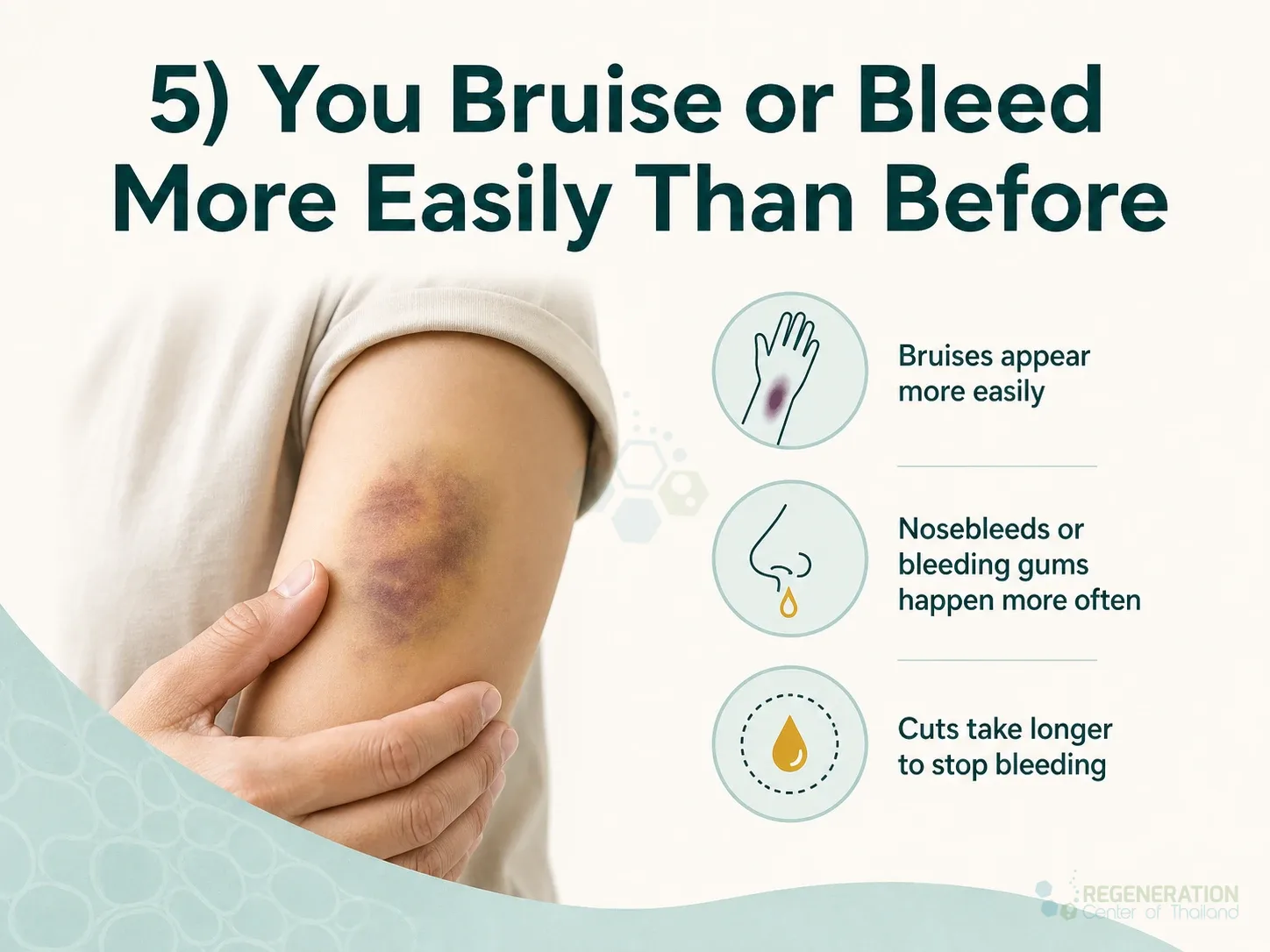
Bruising and bleeding easily are listed among the symptoms that appear as liver function gets worse, so this sign usually means the disease is no longer at an early stage.[6] New easy bruising also has many causes that have nothing to do with the liver, and a blood test is needed to find out which one applies. Vomiting blood or passing very dark or black stools is an emergency.[2]
6) Dark Urine and Pale, Clay-Colored Stools
Bilirubin is a yellow-brown pigment that the liver normally processes and passes into bile, which is part of why healthy stool is brown. When bile cannot reach the gut, bilirubin builds up in the blood and passes out through the kidneys instead, turning the urine dark, like strong tea, even when you drink enough. With less pigment reaching the gut, stools can turn pale, gray, or clay-colored.
This pairing is a sign that bile is not reaching the gut. The cause can be in the liver, such as hepatitis or alcohol-related liver inflammation, or outside it, such as gallstones, narrowed bile ducts, or tumors of the bile ducts or pancreas; some medicines can also do it.[11] See a doctor if your stools are not their normal brown color for several days.[11] If dark urine or pale stools come with yellowing of your skin or the whites of your eyes, ask for an urgent appointment the same day.[12]
7) Puffy Ankles and a Belly That Feels Fuller
A healthy liver makes albumin, a protein that helps hold fluid inside your blood vessels. In cirrhosis, fluid collects in the abdomen (ascites) often because scarring raises the pressure in the veins that carry blood through the liver (portal hypertension), and low albumin adds to it.[13] Swelling of the legs, ankles or feet and of the abdomen appears as liver function gets worse.[6]
Leg and ankle swelling is common and usually has other causes: heart or kidney failure, weak leg veins, pregnancy, some blood pressure and pain medicines, or long periods of standing or sitting.[14] Any new swelling deserves a check. If you already know you have cirrhosis, a swollen abdomen or legs, or difficulty breathing, needs an urgent appointment.[2]
8) Spider Veins, Red Palms, and a Faint Yellow Tint
Spider angiomas are small clusters of blood vessels that fan out from a central red dot, most often on the face, neck, and chest. Palmar erythema gives the palms a blotchy red flush. Both can appear in cirrhosis.[2] Spider angiomas are also very common, often appear during pregnancy, and occur in both children and adults, so one on its own is not a diagnosis; a new one is still worth showing to your doctor.[15]
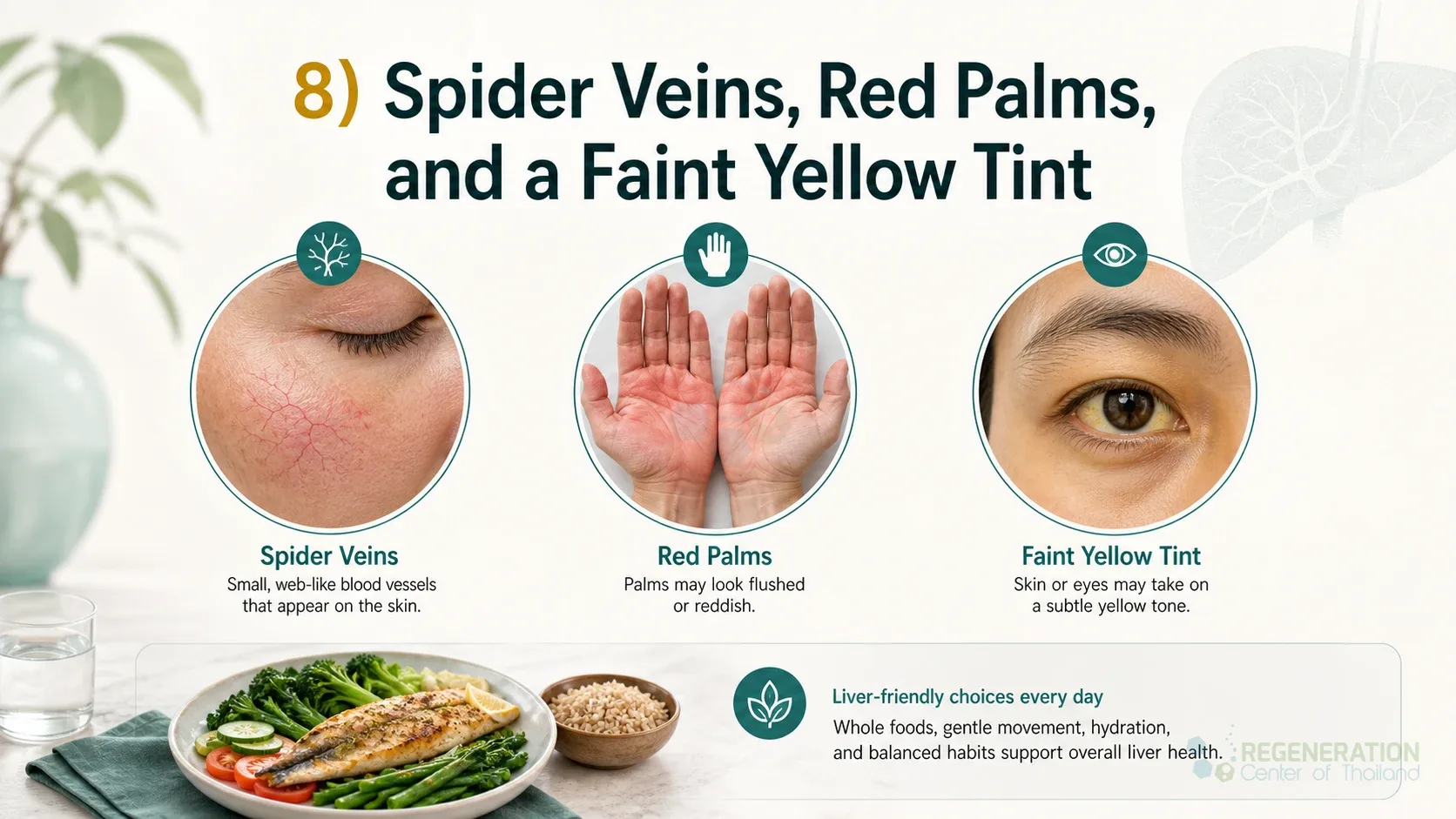
A yellow tint to the whites of the eyes or the skin, called jaundice, is bilirubin becoming visible. It can come from liver disease, including hepatitis and alcohol-related liver disease, and also from gallstones, pancreatitis, or blood disorders such as sickle cell disease.[12] Gilbert syndrome, a common and mild inherited condition, raises bilirubin a little and only rarely causes visible jaundice.[16] Whatever the cause, new yellowing of the skin or eyes needs an urgent appointment the same day, not a wait to see whether it persists.[12] Long-standing liver disease, especially cirrhosis, raises the risk of liver cancer, which is why people with cirrhosis are offered liver cancer screening every six months.[1]
When to Get Urgent Medical Help
Call your local emergency number or go to an emergency department now if you have liver disease, or think you might, and:
- you vomit blood;
- your stools are very dark or black;
- you suddenly become confused, or your speech becomes slurred.[2]
Ask for an urgent appointment the same day if:
- your skin or the whites of your eyes look yellow;[12]
- you have cirrhosis and develop a swollen abdomen, swollen legs, ankles or feet, or difficulty breathing.[2]
See a doctor soon if your stools stay pale for several days, you are losing weight without trying, you have itched for weeks without a skin cause, or you are tired all the time and have risk factors for liver disease.
Who Should Be Tested Even Without Symptoms
Because early liver disease is usually silent, testing is based on risk. Liver guidance advises checking for significant scarring in people with type 2 diabetes, obesity with metabolic complications, a family history of cirrhosis, or significant alcohol use, even when they have no symptoms.[1] The first step is usually a FIB-4 score, calculated from age and routine blood tests. People whose score is not low go on to a scan that measures liver stiffness, such as vibration-controlled transient elastography, and an MRI technique (MRI-PDFF) can measure liver fat precisely, often without the need for a biopsy.[1]
Viral hepatitis is a common and treatable cause of liver damage that also causes no symptoms for years. US public health guidance recommends that every adult be tested for hepatitis C at least once, and for hepatitis B at least once with a three-test blood panel, and that people with ongoing risk factors be tested again.[17][18]
Genes play a part too. A common variant of a gene called PNPLA3 affects how liver cells handle fat and is linked to how often fatty liver occurs and how severe it becomes, but the same guidance does not recommend genetic testing in routine care because the result does not change management.[1]
Lifestyle change is the foundation of treatment for fatty liver disease. In people with excess weight, losing 3 to 5 percent of body weight reduces liver fat, while a loss of more than 10 percent is generally needed to improve inflammation and scarring. A healthy diet, regular exercise, and cutting down on alcohol help even when weight loss is not needed.[1]
When the Liver Needs More Than Lifestyle
Treatment depends on the cause and the stage. Hepatitis C can be cured in most people with 8 to 12 weeks of tablets, and treatment and monitoring of hepatitis B reduce the risk of complications.[17][18] People with cirrhosis need regular specialist follow-up, including screening for liver cancer and for enlarged veins (varices) that can bleed.[1] For end-stage liver disease, liver transplantation is an option.[19]
Several kinds of stem cells, including lab-grown mesenchymal stem cells, have been tested in people with decompensated cirrhosis. A 2025 Cochrane review of 12 randomized trials with 823 adults found the evidence on survival, complications, and liver function very uncertain, and recorded more minor side effects with treatment. The review included only people with decompensated cirrhosis.[19] This research is described further on the page about stem cell research in liver cirrhosis.
Published Clinical Citations
[1] ^ Rinella ME, Neuschwander-Tetri BA, Siddiqui MS, et al. AASLD Practice Guidance on the clinical assessment and management of nonalcoholic fatty liver disease. Hepatology. 2023;77(5):1797-1835. https://doi.org/10.1097/HEP.0000000000000323
[2] ^ NHS. Cirrhosis. https://www.nhs.uk/conditions/cirrhosis/
[3] ^ Harris R, Harman DJ, Card TR, Aithal GP, Guha IN. Prevalence of clinically significant liver disease within the general population, as defined by non-invasive markers of liver fibrosis: a systematic review. The Lancet Gastroenterology & Hepatology. 2017;2(4):288-297. https://doi.org/10.1016/S2468-1253(16)30205-9
[4] ^ Devarbhavi H, Asrani SK, Arab JP, Nartey YA, Pose E, Kamath PS. Global burden of liver disease: 2023 update. Journal of Hepatology. 2023;79(2):516-537. https://doi.org/10.1016/j.jhep.2023.03.017
[5] ^ Swain MG, Jones DEJ. Fatigue in chronic liver disease: new insights and therapeutic approaches. Liver International. 2019;39(1):6-19. https://doi.org/10.1111/liv.13919
[6] ^ National Institute of Diabetes and Digestive and Kidney Diseases (NIDDK). Symptoms and causes of cirrhosis. https://www.niddk.nih.gov/health-information/liver-disease/cirrhosis/symptoms-causes
[7] ^ MedlinePlus Medical Encyclopedia. Cirrhosis. US National Library of Medicine. https://medlineplus.gov/ency/article/000255.htm
[8] ^ Beuers U, Kremer AE, Bolier R, Elferink RPJO. Pruritus in cholestasis: facts and fiction. Hepatology. 2014;60(1):399-407. https://doi.org/10.1002/hep.26909
[9] ^ Levy C, Williams B, Ginchereau Sowell F, et al. Qualitative evaluation of fatigue and pruritus among patients with primary biliary cholangitis. Advances in Therapy. 2026;43(10):4473-4491. https://doi.org/10.1007/s12325-026-03691-4
[10] ^ Peck-Radosavljevic M. Thrombocytopenia in chronic liver disease. Liver International. 2017;37(6):778-793. https://doi.org/10.1111/liv.13317
[11] ^ MedlinePlus Medical Encyclopedia. Stools: pale or clay-colored. US National Library of Medicine. https://medlineplus.gov/ency/article/003129.htm
[12] ^ NHS. Jaundice in adults. https://www.nhs.uk/conditions/jaundice/
[13] ^ MedlinePlus Medical Encyclopedia. Ascites. US National Library of Medicine. https://medlineplus.gov/ency/article/000286.htm
[14] ^ MedlinePlus Medical Encyclopedia. Foot, leg, and ankle swelling. US National Library of Medicine. https://medlineplus.gov/ency/article/003104.htm
[15] ^ MedlinePlus Medical Encyclopedia. Spider angioma. US National Library of Medicine. https://medlineplus.gov/ency/article/001095.htm
[16] ^ MedlinePlus Genetics. Gilbert syndrome. US National Library of Medicine. https://medlineplus.gov/genetics/condition/gilbert-syndrome/
[17] ^ Schillie S, Wester C, Osborne M, Wesolowski L, Ryerson AB. CDC recommendations for hepatitis C screening among adults: United States, 2020. MMWR Recommendations and Reports. 2020;69(2):1-17. https://doi.org/10.15585/mmwr.rr6902a1
[18] ^ Conners EE, Panagiotakopoulos L, Hofmeister MG, et al. Screening and testing for hepatitis B virus infection: CDC recommendations: United States, 2023. MMWR Recommendations and Reports. 2023;72(1):1-25. https://doi.org/10.15585/mmwr.rr7201a1
[19] ^ Aung HH, Naing C, Ni H, et al. Human stem cells for decompensated cirrhosis in adults. Cochrane Database of Systematic Reviews. 2025;11:CD015173. https://doi.org/10.1002/14651858.CD015173.pub2