
Cartilage injuries and Ligament damage, playing sports or living an active lifestyle, can be a painful situation (mentally and physically). Cartilage injuries can impact the knee joints, elbows, fingers, feet, and many other joints. Ligament and cartilage damage are generally the outcomes of blunt force trauma, lupus disease falls, or, most often, sports-related injuries. The cartilage injuries can lead to severe joint discomfort and swelling, and, if left untreated, turn extremely painful in the future.
Most cases of cartilage, ligament, or tendon damage cause pain and swelling that can be managed without surgery. Nevertheless, cartilage injuries may cause persistent pain and additional wear-and-tear damage to healthy knees, which could eventually lead to arthritis and peripheral neuropathy.
Professional athletes have preferred non-surgical remedies such as Orthokine, Regenokine, and our Cell Therapy for Knee injuries, knee arthritis, and cartilage Injuries. Previously, therapies for these types of injuries were constrained by many factors. Today, stem cell cartilage regeneration uses isolated and expanded UC-MSC+ mesenchymal stem cells to treat and regenerate any damaged area in the body, particularly in joints of the knees and hands. This degenerative damage to the joints often happens when articular cartilage deteriorates.
Repair Tendons & Ligaments with Stem Cells
The Regeneration Center’s unique UC-MSC+ cellular protocol focuses on reducing symptoms and signs, as well as the chronic effects of cartilage or ligament damage, through direct stem cell implantation of activated, concentrated stem cells from the patient, or through cord tissue and Platelet Rich Plasma. Our regenerative stem cell hospital offers a unique treatment for cartilage, ligament, tendon, and spinal injuries that significantly helps speed up tissue healing via a targeted and accelerated regeneration process that usually takes Mother Nature months, even years, to accomplish.
Orthopedic Surgery Alternatives
- Alternative to Surgery for Torn or Sprained Ankle Ligaments, Ankle Arthritis, or Ankle Cartilage Damage
- Alternative to Hand Surgery for Injuries or Arthritis
- Alternative to Hip Surgery and Hip Arthritis
- Alternative to Rotator Cuff Surgery for Shoulder Injuries
- Alternative to Surgery for Meniscus Tear of the Knee
Cartilage and Ligament Damage Reversal
Reversing cartilage and ligament damage involves several approaches to promote tissue repair, regeneration, and strengthening. Here are some methods commonly used to reverse cartilage and ligament damage. Anti-aging can mean many things, but in regenerative medicine, Accelerated self-regeneration is possible today thanks to stem cells programmed to divide and create even more stem cells. Isolated and expanded stem cells, growth factors, and progenitor cells are transplanted into the area of injury using direct targeting.
Tissue Engineering
- Scaffold-Based Approaches: Biodegradable scaffolds provide a structural framework for new tissue growth. These scaffolds can be combined with UC-MSC stem cells or growth factors to enhance tissue regeneration.
- Hydrogels and Biomaterials: Developing injectable hydrogels or biomaterials that can deliver cells and growth factors to the damaged area, providing a conducive environment for tissue regeneration
Each approach has its indications, benefits, and limitations, and treatment choice depends on factors such as the extent of damage, patient age, overall health, and specific goals. Combining multiple therapies often yields the best results in reversing or managing cartilage and ligament damage.
Thanks to paracrine signaling, the damaged cartilage becomes a magnet for stem cells, enabling rapid tissue regeneration. The stem cells unite with the cytokines inside of the body. These cytokines help stem cells differentiate into the specific tissue types surrounding them. The process reaches optimal therapeutic impact three to six weeks after treatment.[1]
Stem Cell for Knee Cartilage
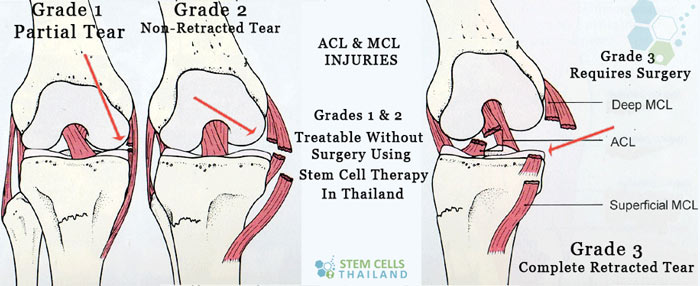
Stem cell Transplants to repair cartilage damage are the safest and most effective non-surgical method for repairing cartilage damage, femoral nerve injuries or tendon injuries. They have rapidly become the preferred treatment for professional sports-related injuries.[2] The Regeneration Center provides the most comprehensive expanded stem cell therapy for sports injuries and sarcopenia worldwide.
Stem cell treatment for Achilles tendon rupture
Achilles tears, tendonitis, and Achilles injuries can be debilitating and take a long time to heal fully. This extremely long recovery period can severely limit a person’s daily routine. Walking around with crutches in constant pain becomes normal for most patients. Additionally, the person risks causing re-rupture, resulting in detachment, which can result in a much more extended recovery period and permanent loss of athletic ability.
Using isolated mesenchymal stem cell therapy, the Regeneration Center Orthopedic+ protocols can help patients with these conditions return to active, healthy lifestyles. We offer clinical applications of the latest stem cell therapy protocols to help patients and weekend warriors recover from injuries, including acute Achilles tendon tears and chronic tendonitis. Our treatment protocols are customized to patient needs and deliver promising results after stem cell therapy for Achilles injuries, a wide range of soft-tissue injuries, bone regeneration, joint pain, and spinal stenosis.
TREATMENT RISKS & PRECAUTIONS
UC-MSC+ Mesenchymal stem cells and regenerative therapies are not appropriate for all types of injuries. Cell therapy and tissue engineering are limited by the severity of the patient’s injury, the patient’s body’s capacity, and other factors such as overall health, age, and genetics. Patients with severe degenerative changes, advanced osteoarthritis, heart disease, significant joint instability, or large-scale tissue damage, or those with travel limitations, might not be good candidates for treatment.Cartilage, Achilles Tendon & Supraspinatus Regeneration
Number of Stem Cell Injections for Ligament and Cartilage Damage: 2-8 sessions of Isolated & expanded mesenchymal stem cells ( UC-MSC+) Infusions per stage
Types of Stem Cells and Cell Delivery Methods: For patients with moderate degeneration, multiple sessions of clinical grade expanded UC-MSC+ Mesenchymal Cells will be recommended along with our proprietary mix of tissue-specific growth factors that can include Platelet-Derived Growth Factors (PDGF), Connective Tissue Growth Factors (CTGF), Transforming Growth Factor-beta (TGF-β), Bone Morphogenetic Proteins (BMPs), Insulin-like Growth Factor-1 (IGF-1), Vascular Endothelial Growth Factors (VEGF), Fibroblast Growth Factors (FGF), Epidermal Growth Factors (EGF), and Nerve Growth Factors (NGF). The length and scope of the regenerative therapy protocol will depend on the patient’s actual medical needs. Our autologous protocol requires 2-4 weeks of cell culture before cells can be used in therapy, whereas the allogeneic UC-MSC+ protocol does not require invasive surgery or additional wait times. Isolated cells and growth factors are delivered via intravenous drips, direct local injections, intradiscal or intrathecal injections, fluoroscopy-guided stem cell delivery (in a hospital setting only), or a combination of these methods to achieve optimal results.
Rehabilitation Treatment for Cartilage, Ligament, and Tendon Damage: Physical Rehabilitation therapy at Bangkok Hospital is optional but highly recommended, depending on your travel/time constraints. Complete physical rehabilitation is available upon request, with 2-4 hours per day, up to 6 days per week. Medical visas and accommodations for an extended stay for the patient and family can also be included upon request.
Total Treatment Length: estimated around 10-14 days (depending on the severity of the patient’s injuries)
Benefits of Stem Cells for Tendon Repair & Cartilage Loss
Treatment for cartilage and ligament damage using enhanced mesenchymal stem cells (UC-MSC+) will require approximately two weeks at our treatment facilities in Central Bangkok.
Due to varying degrees of underlying injuries, our orthopedic team must evaluate all potential patients before developing a detailed treatment plan that includes the required number of days and the total medical costs (excluding accommodations or flights). To begin the medical evaluation of our multi-stage treatment protocol, please prepare your recent records (MRI/CT Radiology Scans) and contact us today.
Published Clinical Citations
[1] ^ Ong, Edward, Mukai Chimutengwende-Gordon, and Wasim Khan. 2013. Stem cell therapy for knee ligament, articular cartilage, and meniscal injuries. Current stem cell research & therapy, no. 6. https://www.ncbi.nlm.nih.gov/pubmed/24016325
[2] ^ Pelaez, Daniel, Chun-Yuh Charles Huang, and Herman S Cheung. 2013. Isolation of pluripotent neural crest-derived stem cells from adult human tissues by connexin-43 enrichment. Stem cells and development, no. 21 (July 27). doi:10.1089/scd.2013.0090. https://www.ncbi.nlm.nih.gov/pubmed/23750535
[3] ^ Sekiya, Ichiro, Miyoko Ojima, Shiro Suzuki, Mika Yamaga, Masafumi Horie, Hideyuki Koga, Kunikazu Tsuji, et al. 2011. Human mesenchymal stem cells in synovial fluid increase in the knee with degenerated cartilage and osteoarthritis. Journal of orthopaedic research : official publication of the Orthopaedic Research Society, no. 6 (December 6). doi:10.1002/jor.22029. https://www.ncbi.nlm.nih.gov/pubmed/22147634